- Chapter 6: Boats & Vessels — The Platform That Determines Everything
- The Universal Reality of Boil Hunting
- Japan’s Cultural Revolution: From Shared Boats to Private Fleets
- The Casting Rail: Engineering Japan’s Fighting Advantage
- Bridging Ideal and Reality
- Global Vessel Diversity: Beyond the Center Console Stereotype
- Regional Vessel Cultures
- Global Charter Economics
- The Physics of Fighting Philosophy
- Sources
Chapter 6: Boats & Vessels — The Platform That Determines Everything
In bluefin tuna casting, nothing shapes an angler’s tactics more fundamentally than the boat itself. A vessel is far more than transportation—it is the platform you stand on, the structure that absorbs the fish’s power, and in every practical sense, the most critical piece of tackle in your arsenal.
The Universal Reality of Boil Hunting
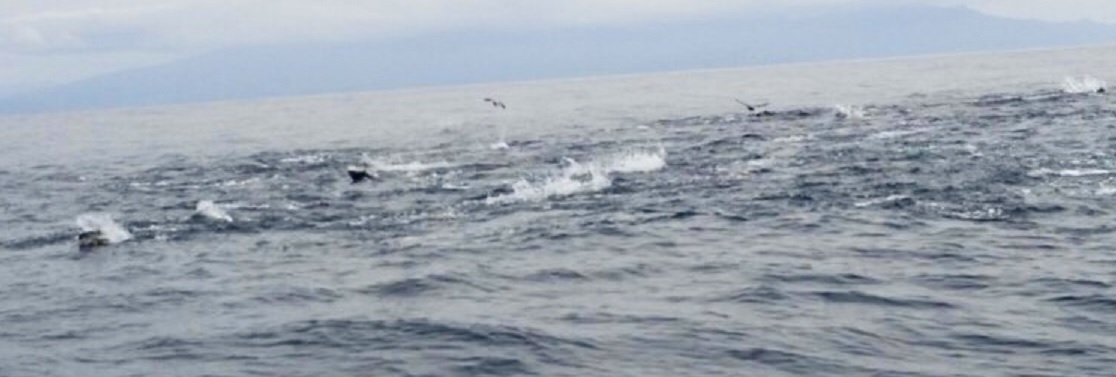
One aspect of tuna casting remains identical worldwide: spotting surface activity is never just the captain’s job. Every person on board is part of the search team. International forums consistently emphasize “All eyes on the water” as fundamental doctrine. The captain monitors radar, sonar, and navigation while the crew scans for birds, surface boils, and baitfish activity.
Once a boil erupts, the race begins. Sometimes it happens right beside the boat; other times you’re looking at a five-minute sprint. Boils can vanish in seconds or persist for twenty minutes when conditions align perfectly. “You make it when you make it—and when it disappears, it’s gone in an instant.” This is the unforgiving reality of fishing against wild nature.
Japan’s Cultural Revolution: From Shared Boats to Private Fleets
Japanese bluefin casting has undergone a quiet but profound transformation entering the 2020s.
The traditional shared-boat model paired strangers together, four to six per vessel. When one angler’s fight exceeded an hour, everyone else stopped fishing. This social pressure—the unspoken rule of “finish quickly”—became a powerful driver in developing high-drag, short-battle techniques.
Today’s reality tells a different story. Shared charters are declining rapidly, replaced by full-boat bookings and privately owned vessels. The catalyst is clear: bluefin casting’s extreme skill gap between novices and veterans. When beginners hook up on shared boats, the impact on everyone else’s fishing can be substantial.
Private charters and personal boats eliminate the old tension entirely. A long fight might draw good-natured ribbing—”Come on, wrap this up!”—but nothing more serious. Yet Japanese anglers haven’t abandoned the “stop the fish” philosophy. Even freed from time constraints, this approach persists because it has proven to be the most efficient and reliable method for landing bluefin under Japanese conditions.
The Casting Rail: Engineering Japan’s Fighting Advantage
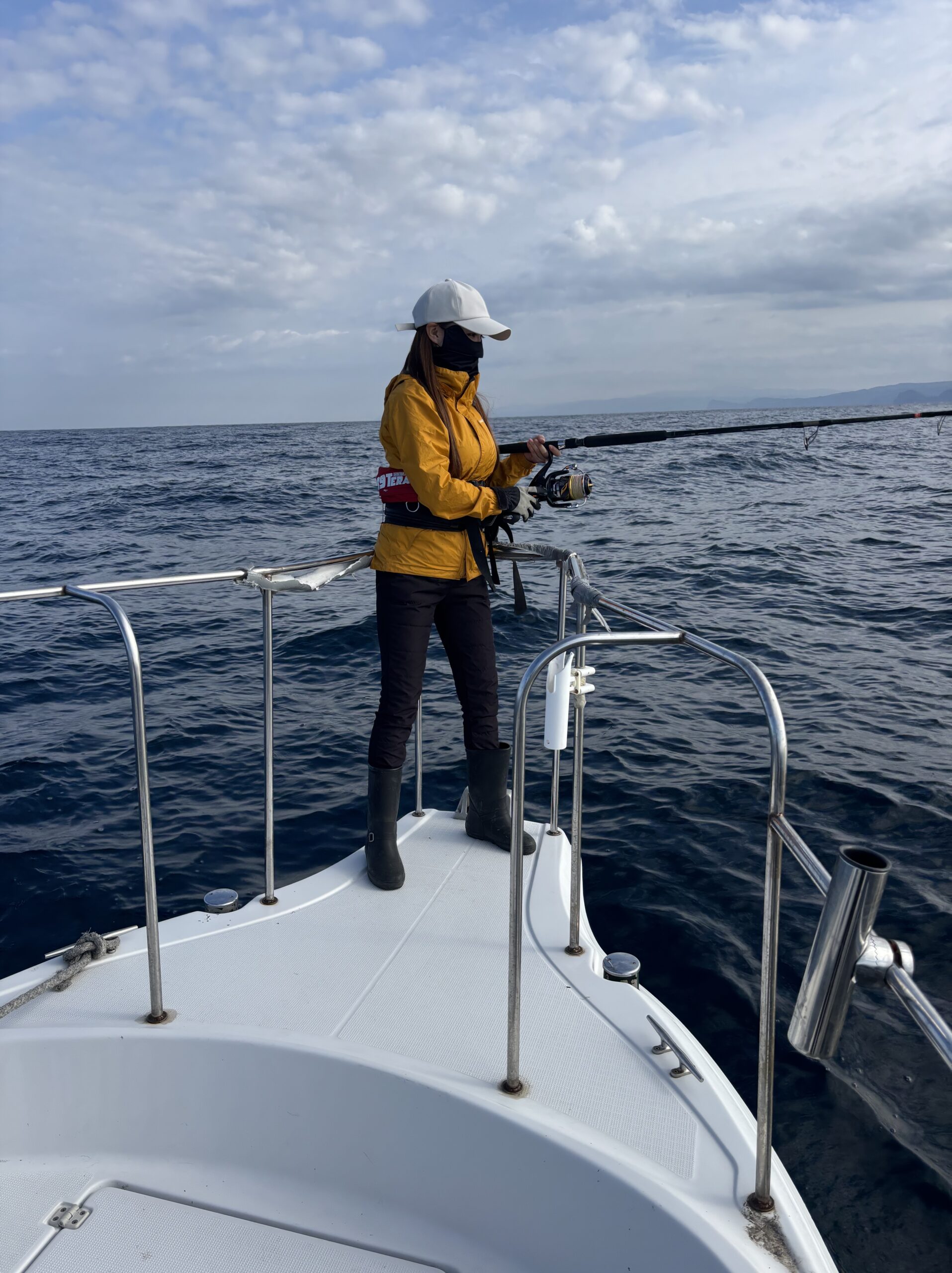
The signature feature of Japanese tuna boats is the bow-mounted casting rail—stainless steel tubing arranged in an inverted U-shape, standing 70–90 cm above deck level. These rails are bolted and secured to withstand a full-grown adult leaning their complete body weight without any flex or movement.
Crucially, these are aftermarket installations in virtually every case. Japan’s robust boat customization culture drives owners to modify stock pleasure boats extensively for specialized fishing applications. The rail installation process has become integral to the sport itself.
This engineering creates a tactical revolution. When the fish runs right, the angler pivots right. Left run, left pivot. Deep dive, rod tip drives down toward the hull. Complete 360-degree fish control from a single, fixed fighting position. This absolute anchor point enables the safe application of 15-kg drag loads that would be dangerous or impossible on open, unsupported decks.
Bridging Ideal and Reality
Every Japanese newcomer learns “stop the fish” as fundamental doctrine. But the ocean doesn’t grade on intentions.
The expert standard: PE12 line, 15-kg drag, body braced against the rail, targeting the shortest possible fight duration.
The learning curve reality: Fifteen kilograms of drag creates enormous physical demands. When a giant bluefin explodes into its first run, the raw power can overwhelm even prepared anglers. Instinctively reducing drag for safety and control is a natural, sensible response—not a failure. The result often resembles international “let it run” tactics, with line peeling at high speed.
This matches Chapter 4’s core finding: “The ideal is stopping the fish, but reality sees many anglers being run.” Progressing toward the “stop the fish” ideal while experiencing a “learning to manage the run” phase represents completely normal skill development. Every expert has walked this path. This progression is part of what makes bluefin casting endlessly challenging and rewarding.
Global Vessel Diversity: Beyond the Center Console Stereotype
The assumption that “international = American center console” severely understates global diversity. Surveying 25 countries reveals extraordinary vessel variety, each adapted to local conditions, regulations, and fishing heritage.
| Vessel Category | Primary Regions | Key Characteristics | Fighting Philosophy |
|---|---|---|---|
| FRP Charter Vessel | Japan (All Regions) | Bow casting rails, customization culture, bow-focused layout | High drag, rapid resolution |
| Center Console | US East Coast, Hawaii, Australia | 360° mobility, multiple outboards, extreme speed capability | Low drag, pursuit-based |
| RIB (Rigid Inflatable) | Gibraltar, Croatia, Ireland/UK | Inflatable tubes as bracing points, superior seakeeping | Medium drag, mobile stability |
| Sport Fisher | Canada PEI, Mediterranean | Large stable platforms, trolling capability, stern-focused | Medium-high drag, endurance |
| Modified Lobster Boat | Canada PEI, Nova Scotia | Extreme beam width, giant bluefin specialists | Extended fights, crew rotation |
| Catamaran | South Africa (Cape Town) | Twin-hull stability, rough-water capability | Medium drag, stability-focused |
| Traditional Conversions | Maldives, Indonesia, Middle East | Dhoni/panga modifications, GT crossover capability | Low-medium drag, adaptive |
Regional Vessel Cultures
Strait of Gibraltar (Spain): Anglers target 200–600+ lb bluefin from RIBs, using the thick inflatable tubes as natural bracing points during fights. This solves the same stability challenge as Japanese rails through completely different engineering. Japanese-style “Sasoi-dashi” (luring fish up without visible surface activity) is increasingly adopted here during winter months.
Canada PEI/Nova Scotia: Modified lobster boats specialize in 500–1000+ lb giants under strict catch-and-release mandates. Multi-hour fights are standard operating procedure. Extreme beam width and stern-mounted fighting chairs are purpose-built for these extended battles.
South Africa (Cape Town): Catamarans dominate the notoriously rough “Cape of Storms” waters. Twin-hull stability and wide, flat decks handle the powerful Agulhas Current (2–5 knots) while maintaining casting capability in challenging conditions.
Maldives/Indonesia: Traditional dhoni and panga boats serve the budget charter market after conversion for sport fishing. Notably, Japanese-operated charters in these regions increasingly retrofit casting rails—early evidence of Japan’s “stop the fish” philosophy spreading internationally.
Global Charter Economics
| Region | Booking Model | Rate Range | Per-Person Cost (4 anglers) | Market Characteristics |
|---|---|---|---|---|
| Indonesia/Fiji | Full boat charter | $150–400/boat | ~$40–100/person | Budget tier, GT/tuna crossover |
| Japan | Shared → Private transition | ¥20,000–35,000/person | ¥20,000–35,000/person | Skill gap driving privatization |
| Mediterranean | Full boat charter | €450–1,500/boat | ~€115–375/person | Mixed methods, regulation compliance |
| US East Coast | Full boat charter | $1,200–3,000/boat | ~$300–750/person | Center console dominance, high-speed tactics |
| Canada PEI | Full boat charter | CAD$2,500–4,500/boat | ~CAD$625–1,125/person | Giant specialists, mandatory C&R |
International charters operate almost exclusively on full-boat booking models—friends and family occupy the entire vessel. Extended fights become shared adventures rather than individual inconveniences. Three-hour battles earn cheers and crew rotation rather than complaints, fundamentally enabling the low-drag, endurance-based international approach.
The Physics of Fighting Philosophy
The causal mechanism:
Vessel structure (bracing availability) → Fighting anchor points → Sustainable drag levels → Tactical evolution → Tackle development direction
Japan’s “stop the fish” methodology, America’s “let it run and chase” tactics, and Europe’s RIB-based approaches all represent optimal solutions within their respective physical and economic constraints. The boat is the ultimate tackle—its design determines every aspect of the fight that follows.
Sources
| Source | Coverage | URL |
|---|---|---|
| FishingBooker | Global charter rates and vessel specifications | fishingbooker.com |
| 360tuna.com | International angler reports on boil hunting and fight tactics | 360tuna.com |
| The Hull Truth | Center console design, rail configurations, offshore boat discussions | thehulltruth.com |
| PEI Bluefin Tuna Charters | Canada giant bluefin specialist vessels and pricing | peibluefintunacharters.com |
| Fisheries Ireland — Tuna CHART | Irish/UK catch-and-release programs and RIB utilization | fisheriesireland.ie |
| On The Water Magazine | US East Coast boil hunting and tactical analysis | onthewater.com |
| Salty Cape | Cape Cod charter operations and center console tactics | saltycape.com |
| Drytide Gear | Adriatic Sea RIB tactics and vessel characteristics | drytidegear.com |
| Gamefishing Asia | Indian Ocean traditional vessel conversions and operations | gamefishingasia.com |
| VARIVAS — Ichiro Sato | Japanese high-drag techniques and casting rail utilization | varivas.co.jp |
| Anglers Time — Ichiro Sato | Japanese vessel culture, customization practices, and fight philosophy | anglers-time.com |
Next: Chapter 7 — Fish Finders, Radar, and LiveScope: Is This Still “Fishing”? Or Has It Become Something Else?

コメント