Chapter 5: Japan vs. the World — The Philosophy and Structure of Bluefin Tuna Casting Tackle
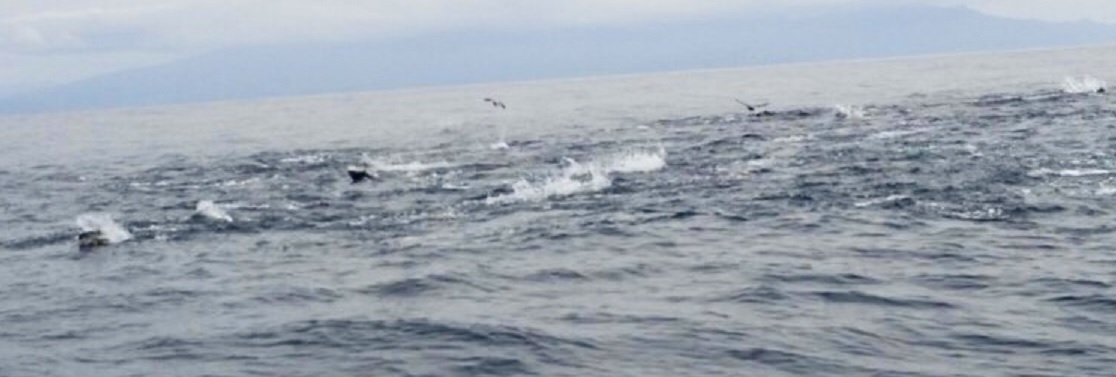
In the world of bluefin tuna casting, a fascinating divide exists. Japanese anglers and their counterparts in the United States, Australia, and New Zealand target the same species — bluefin and yellowfin tuna — yet their tackle philosophies are fundamentally opposed. This isn’t just about different brands or preferences; it represents two entirely different approaches to conquering one of the ocean’s most powerful predators.
The Japanese philosophy can be distilled into four words: stop the fish immediately. Using heavy PE8–12 braided line with crushing drag settings of 13–15 kg, the goal is to control the fish from its very first run and end the fight as quickly as possible. Ichiro Sato, the pioneer who has stood at the forefront of Japanese bluefin casting since its birth, explains in a VARIVAS interview: “For PE12 tackle, I set the initial drag at around 13–15 kg.” He describes a sophisticated braking system — when a larger-than-expected fish strikes, he first applies hand drag (physically palming the spool), and only tightens the mechanical drag if that fails. The ultimate goal, he says, is “to land the fish without touching the drag at all.” This approach demands lightweight rods, reels with enormous drag capacity, and lines engineered to withstand the extreme heat generated by high-tension release. Each fight is brief but brutal, pushing every component to its absolute performance limit.
The international approach represents the complete opposite philosophy: let the fish run and tire it out. Using lighter PE5–8 line with moderate drag settings of 8–12 kg, anglers allow the fish to make its runs, then steadily recover line as it exhausts itself. Fight times stretch longer, but the peak stress on individual tackle components remains manageable. The priorities are durability, versatility, and cost-effectiveness — a single rod or reel often serves multiple fishing applications rather than being purpose-built for tuna.
These contrasting philosophies aren’t about superiority; they’re products of different fishing cultures and evolutionary paths. Japanese tuna casting developed independently, creating a sophisticated technical framework that alternates between two fighting modes: maintaining the rod high and deeply bent to apply sustained pressure, and switching to straight-line fighting during recovery periods. As Sato explains: “Fighting with the rod properly loaded brings the fish up in about half the time compared to straight-line fighting — but you can’t maintain that position constantly, so sometimes you must point the rod directly at the fish and rest.” This constant switching between “loading” and “enduring” defines every aspect of Japanese tackle design. Internationally, tuna casting evolved from offshore trolling culture, driving tackle development toward versatility rather than specialization.
Rods
Japanese tuna casting rods emerge from small-scale workshops operating at near-artisanal levels. The SOULS Oceans Level PS-O83L10S measures 8.3 feet, weighs just 387 g, and handles PE10 line. Ripple Fisher’s legendary BIG TUNA 710 spans 7 feet 10 inches, weighs 393–407 g, handles PE6–12. and has built an impressive track record against 200+ kg bluefin since its 2010 debut. MC Works’ SH758TSZ measures 7.5 feet for PE12, while ZENAQ’s Tobizo TC84-100G reaches 8.4 feet for PE8. All command premium prices of ¥70,000–100,000+, utilizing advanced materials like carbon nanoalloy to achieve the seemingly impossible: sub-400g weight combined with the backbone to stop 100+ kg fish.
The design philosophy behind Sato’s SOULS rods — and Japanese tuna rods generally — begins with one fundamental assumption: the angler will fight with the rod held high and fully loaded. Unbreakable flex and lifting power take absolute priority. These rods are engineered so the rod’s power does the work, not the angler’s arms, preserving energy through a full day of casting and fighting until the crucial final moments.
International manufacturers take a different approach. Spain’s Höwk Fishing offers the Bullfighter 150 (8.3 ft, PE6, 390 g, $549) and Bullfighter 300 (7.2 ft, PE12, 560 g, $699), using T1K carbon in a direct challenge to Japanese performance standards. US-based United Composites sells bare blanks for $350–450, supporting a thriving custom-build culture where anglers personally assemble guides and grips. Their dual carbon helix construction delivers impressive strength-to-weight ratios, with finished builds running $500–700 — but the hands-on process creates deep trust and attachment that sustains this entire culture. OTI’s Tuna Sniper costs $470 for 7.6 feet, while Hogy Lures offers a 7-foot MH model at $295.95 — both delivering roughly half to equivalent performance at half the Japanese price.
The trade-off is weight. Most international rods carry 30–100 g more mass than Japanese equivalents. This difference vanishes on a single cast but accumulates as significant fatigue over a full day of repeated casting. However, for charter boat fishing with limited casting volume — perhaps a few dozen casts daily — international rods offer compelling cost-to-performance ratios.
Reels
Between 2025 and 2026, an unprecedented development occurred: Shimano and Daiwa simultaneously refreshed their flagship spinning reels, signaling a new era in Japanese big-game fishing.
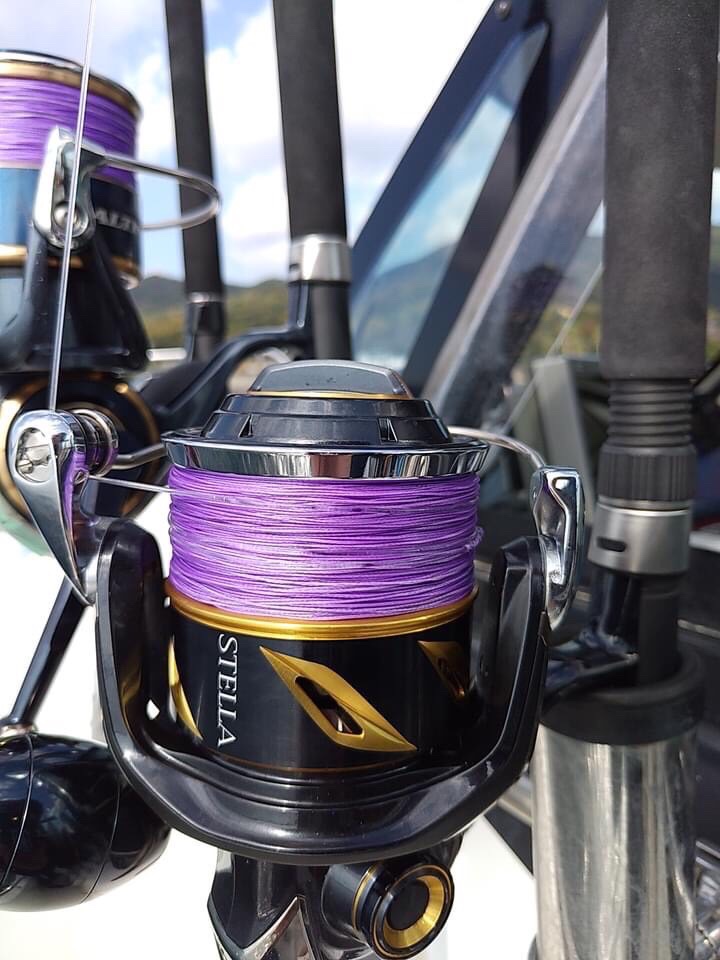
Shimano’s 25 Stella SWD launched in May 2025 with the 10000PG, 10000HG, and 14000XG at ¥160,000 (before tax). The revolutionary XX Tough Drag system positions large-diameter carbon washers above and below the drag stack, reducing heat-induced performance loss by approximately 30%. InfinityLoop employs dual-speed oscillation, winding line at half the conventional pitch to prevent dig-in under extreme drag loads. InfinityXross expands gear tooth contact area by 1.3x, boosting both cranking power and long-term durability. April 2026 brought additional models: 18000HG, 20000PG, and the game-changing 25000PG.
Daiwa’s 25 Saltiga introduced DRD (Daiwa Roller Drag), an eight-roller system delivering dramatically superior heat resistance compared to traditional carbon washers. Sato describes this evolution: “DRD mechanically performs what advanced anglers previously did manually with hand drag.” Traditional carbon washers would lose effectiveness after 100 meters of high-drag runs, requiring constant readjustment. DRD maintains consistent drag values as components cool, virtually eliminating mid-fight adjustments. Pricing ranges ¥170,500–200,000 depending on size, with street prices around ¥112,000–127,000 for the 14000 class. Maximum drag reaches 30 kg with 14 bearings.
The most significant development is the emergence of the 25000 size class. Previously, Japanese anglers targeting 100+ kg bluefin relied on Stella SW 18000HG (875 g) or 20000PG (885 g) bodies paired with separately purchased Yumeya 20000 MAX Spools (80 mm diameter, 28 kg max drag) to accommodate 300 m of PE12. The Stella SW 30000 (975 g, 25 kg max drag) offered sufficient capacity but carried weight penalties and actually delivered less drag than the 18000 + MAX Spool combination.
The new 26 Stella SW 25000PG (released April 2026) changes everything: 920 g weight, 79.5 mm spool diameter, 30 kg maximum drag, and 300 m PE12 capacity on the stock spool. Daiwa’s Saltiga 25000-P matches these specifications at 945 g. Both eliminate the need for aftermarket spool upgrades while exceeding previous drag capabilities. As one blogger noted: “The 25000PG holds 300 m of PE12 straight from the box — no MAX Spool required.” Years of workaround solutions have been rendered obsolete by purpose-built engineering. The 25000 class is poised to become the new standard for Japanese bluefin casting.
International alternatives exist but carry compromises. Penn’s Authority ATH-10500 delivers comparable 27.2 kg (60 lb) drag, 13 bearings, and IPX8 waterproofing for $599.95 — less than half the Japanese street price. However, its 1,057 g weight exceeds even the “too heavy for casting” Stella SW 30000 by over 80 g. Van Staal’s VR series offers outstanding corrosion resistance via 6061 aluminum construction, but its 25 lb maximum drag falls short of high-pressure Japanese fighting requirements.
The Stella versus Saltiga debate remains eternal in Japanese tuna circles. Stella advantages include lighter weight, silky retrieval, and mechanically guaranteed line lay via InfinityLoop. Saltiga strengths center on DRD’s thermal stability and reduced adjustment requirements. Either choice demands ¥120,000+ investment, with big-game 18000+ sizes approaching ¥150,000. Penn’s $600 alternative delivering similar drag numbers starkly illustrates the price structure gulf between Japanese and international tackle cultures.
Line
In tuna casting, how you spool your line matters more than which line you choose. This principle reveals the most fundamental cultural difference between Japanese and international approaches.
Japanese anglers rely on premium lines like VARIVAS Avani Casting PE Si-X and YGK X-Braid, with PE8–12 in 300 m costing ¥12,000–20,000. Si-X incorporates proprietary heat-resistant fibers during the raw yarn stage — before braiding — rather than applying surface coatings afterward. This structural approach prevents performance degradation as coatings wear away. Sato explains: “Si-X was developed specifically to withstand violent bluefin runs and reduce frictional heat at line rollers and guides.”
But line selection represents only half the equation. Spooling methodology proves equally critical.
Japanese tackle retailers traditionally offered complimentary spooling when customers purchased reels or lines in-store. This practice is evolving — one major chain announced fee-based spooling starting April 2026, citing inability to “continue absorbing costs through operational efficiencies.” Even in Japan, free spooling is becoming history.
Japan’s decisive advantage lies in widespread professional-grade tensioning equipment. Many specialty shops operate machines like the IK-500 Ver.2 (Uoya × Studio Ocean Mark collaboration) or Daiichi Seiko’s High-Speed Recycler 2.0. Social media announcements of “IK-500 installation for large-reel spooling” are commonplace. The tension standard comes directly from Sato: “For PE5 and above, line number × 500 g provides a safe guideline.” This translates to 4 kg for PE8, 5 kg for PE10, 6 kg for PE12. Japanese pro shops apply these precise values using calibrated tensioners, add PE coating every 100 m, and fine-tune spool geometry with washers for perfectly flush fills.
International spooling culture operates entirely differently. US chain stores provide free spooling up to 300 yd with reel purchases, while Australian chains offer purchase-day complimentary service and AU$9.99 walk-in rates. US specialty shops typically charge $10–50 for customer-supplied line. Forum discussions reveal cultural attitudes — complaints about $14 spooling fees meet responses like “that’s cheap — other shops charge $50,” reflecting awareness of spooling as paid technical service.
More significantly, tension management methodologies diverge completely. US forums widely share techniques like wet towel line control, bucket-floating spools, or chopstick-and-foot improvisation. While 360tuna forum experts recommend “8–10 lb tension — use a machine,” this represents a small minority of dedicated big-game specialists. Most anglers lack frameworks for numerical tension management.
Interestingly, the actual tension numbers overlap between cultures. Sato’s “line number × 500 g” standard (4 kg for PE8, 6 kg for PE12) and US expert recommendations of 8–10 lb (3.6–4.5 kg) fall within similar ranges. The crucial difference lies in implementation: Japanese shops achieve these values through calibrated machinery ensuring consistency and reproducibility, while international approaches rely on individual feel and experience.
This gap becomes critical during Japanese-style 13–15 kg drag fighting. Uneven spooling causes line-to-line dig-in under extreme loads, triggering release failures and braid breakage. When PE8–12 operates near 30 kg drag, spooling precision directly determines success or failure. International PE5–8 systems running 8–12 kg drag tolerate imperfect spooling without practical consequences.
Popular international lines include PowerPro Super 8 Slick V2 (80 lb / 300 yd, $38.49) and Daiwa J-Braid Grand X8 (Japanese-made, $25–35), available at one-third to one-fifth of premium Japanese prices. While conceding heat resistance and consistency to VARIVAS Si-X or YGK X-Braid, they perform excellently for international fighting styles, making cost differences entirely rational.
Conclusion
Japanese tuna casting tackle represents more than excellent individual components — it embodies an integrated system where heat-resistant lines, precision machine spooling, lightweight rods, and high-drag reels optimize collectively. Remove any element and the entire 13–15 kg “stop the fish” philosophy collapses. Sato’s practice of preparing ten spare spools per trip, each pre-rigged with perfect knot systems, exemplifies this systems thinking.
International tackle excels at individual cost-performance ratios. Penn reels deliver comparable drag for less than half Stella prices. United Composites blanks, self-assembled, provide equivalent strength at half the cost of finished Japanese rods. PowerPro lines cost fractions of Japanese premiums while performing admirably for international fighting styles. The equation roughly yields 80% performance for less than half the price.
However, the final 20% — extreme heat resistance, machine-reproducible spooling precision, and sub-400g rods capable of stopping 100+ kg fish — remains difficult territory without complete Japanese systems. The simultaneous 2025–2026 Stella SWD and Saltiga refreshes, plus 25000 size introductions, have intensified competition for this performance margin. Stella’s InfinityLoop mechanically guarantees line lay precision, while Saltiga’s DRD structurally solves heat management. Both technologies serve one purpose: stopping the fish. Japanese fighting philosophy continues driving manufacturer development forward.
Next, we examine the platforms carrying this tackle. Chapter 6: Boats and Vessels explores how three distinct boat cultures — Japanese charter vessels, American center consoles, and Mediterranean charter boats — influence tuna casting tactics and success rates worldwide.
Reference Sources
| Category | Content | Source |
| Ichiro Sato – Tackle Philosophy | Drag settings, fight theory, line strength | VARIVAS – Ichiro Sato Tackle Analysis |
| Rods (Japan) | SOULS product specifications | SOULS SALT ROD |
| Ripple Fisher BIG TUNA | Ripple Fisher | |
| MC Works / ZENAQ | Official manufacturer websites | |
| Rods (International) | International rod specs and pricing | Höwk Fishing, United Composites, Hogy Lures |
| Reels | 25 Stella SWD / 25 Saltiga | Shimano Fish, Daiwa 25 Saltiga |
| Line & Tools | PE line and tensioner information | VARIVAS, Studio Ocean Mark, Daiichi Seiko |
| International Market Culture | Overseas forum discussions | 360tuna.com |

コメント